Reflections
On Maintenance
Nobody is thanked for the outage that did not happen. This is a reflection on the largest category of good work there is, and the one least visible from outside it.
AI-assisted Reasoned position
The story we tell about technology is a story about beginnings. Something is invented, launched, released, shipped. There is a moment, and then the moment passes, and the thing is simply there.
Almost everything true happens after that.
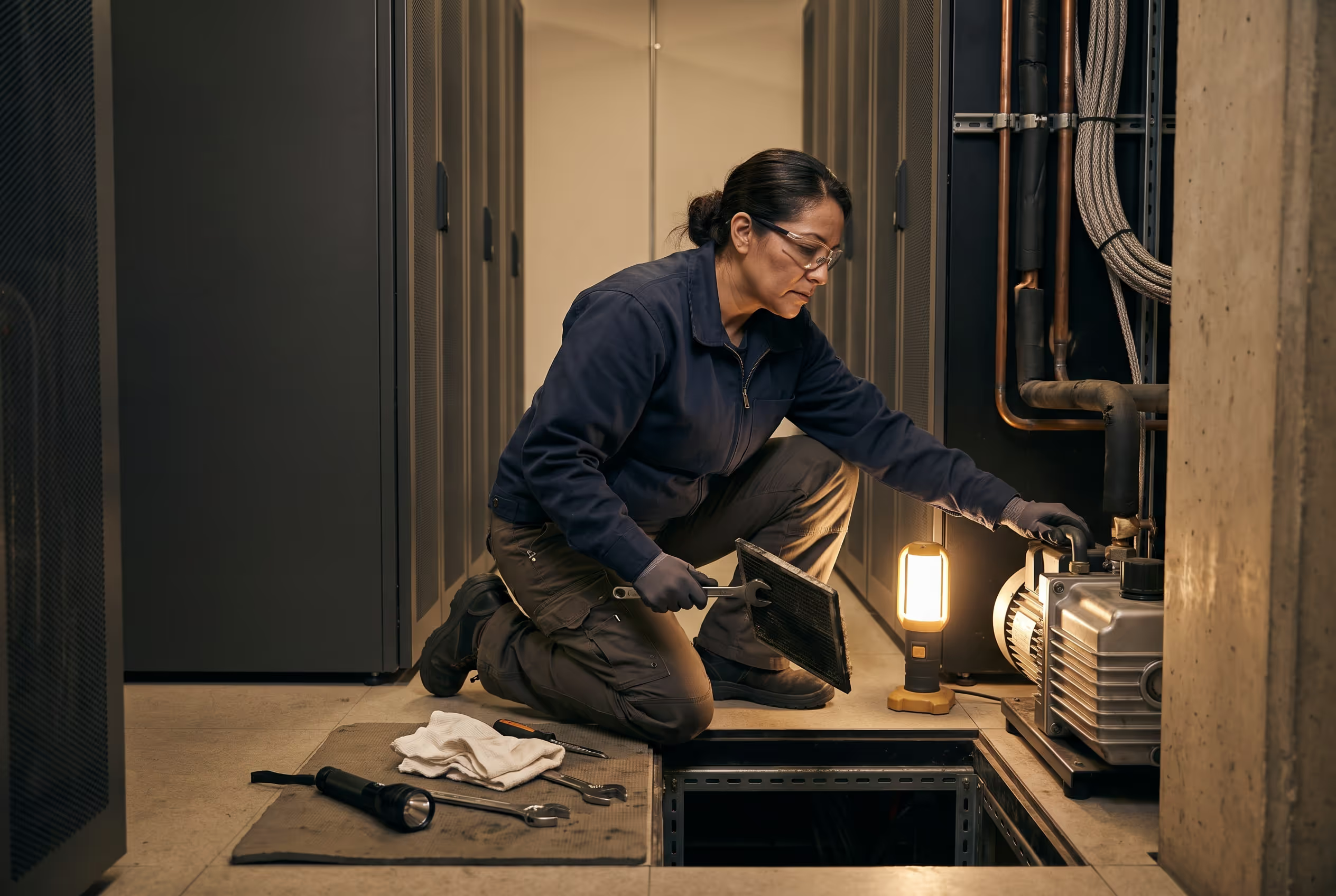
The system that was launched is now being watched by someone at unsociable hours. Its dependencies are being updated. Its certificates are being renewed before they expire. Its disks are being replaced one at a time by a person who drives to a building in an industrial estate. Its documentation is being corrected by whoever last discovered it was wrong. Its edge cases are being handled by staff who have learned the workarounds and never wrote them down. Its slow leak of unnoticed error is being absorbed, daily, by people who have stopped mentioning it.
None of this is in the story. There is no launch for the fourth year of something continuing to work.
Why it is invisible by construction
Maintenance produces an absence. The outage did not happen, the data was not lost, the bridge did not fail. Absences are unobservable; there is no version of the day in which everyone experiences the disaster they were spared and knows to be grateful.
Worse, maintenance is most visible when it has failed. The only time most people think about the people who keep a system running is the morning it stops running, and their first thought is not admiration. This is a genuinely cruel arrangement: the profession’s entire public reputation is built from its worst days, because its good days are indistinguishable from nothing happening.
And it does not photograph. A launch has a moment. Upkeep is a Tuesday, and then another Tuesday.
What it actually consists of
It is not one thing. Working from the mundane upward:
Replacement. Parts wear out. Something must be identical enough to swap in and different enough to be new. Somebody keeps the stock, knows the part number, and has climbed the ladder.
Reconciliation. The world changes underneath a system that assumed it would not. A format is deprecated, a supplier stops, a law changes, a name that was unique stops being unique. Nothing failed. Everything must be adjusted.
Restraint. Most of maintenance is deciding not to do things. Not to upgrade this week. Not to accept the elegant refactor before the release. Not to take the interesting risk on a system that other people depend on. This is the part that is least like heroism and most like adulthood.
Memory. Knowing why the strange thing is there. Every long-lived system contains decisions whose reasons have been forgotten, and the person who removes one without knowing why is about to rediscover it. Maintenance is largely the practice of holding a reason for something long after everyone who cared about it has left.
Absorption. The most costly and least acknowledged. Somebody is standing between a system’s imperfections and the people it serves, and translating, apologizing, and working around. That labor does not appear in any accounting of the system’s cost, and it is where the real price of a design shortcut is paid.
Why we think it is a spiritual matter
We are wary of that phrase, because it can be used to dignify anything, and calling someone’s underpaid work spiritual is a way of not paying them more. So we want to say precisely what is meant.
Three things.
It is fidelity in the absence of an audience. Almost every account of a virtuous life has held that what you do when nobody is watching is the part that counts. Maintenance is that condition made permanent. There is no observer, no applause, and the reward for doing it perfectly is that nothing occurs. If character is formed by repeated action, this is the purest available material.
It takes the created thing seriously. To build something and then leave is to have been interested in the making rather than the thing. Continuing attention is what distinguishes having made something from having had an idea, and it is the point at which a creator’s relationship to their work resembles anything one would call responsibility.
It is directed at people who will never know. A maintained system serves strangers, most of whom will never learn that anything was done for them. Care given to people who cannot thank you is not a lesser kind of care. It is arguably the kind that most needs a practice behind it, because nothing in the situation will sustain it.
What follows, practically
Say who did it. The most useful single change available to most organisations is to name the maintainers somewhere the rest of the organization can see. Not as ceremony — as information. A great deal of contempt for upkeep comes from a genuine ignorance of how much of it there is.
Count it as work. If the plan has no time in it for the fourth year of something, the plan is fiction, and the shortfall will be made up out of somebody’s evenings.
Notice the absences once. Once, this week, when something works — a payment clears, a door opens, water arrives — hold for a moment the fact that this required people, and is still requiring them. Not as gratitude theater. As an accurate perception of the world, which most of the time we simply do not have.
There is a practice on this site about repair, and one about ending things well, and this reflection sits between them. But the ordinary version needs no practice at all. It is only this: the world is not standing. It is being held up, continuously, by people you will not meet, and the holding is the work.
Questions to sit with
- What am I currently benefiting from that somebody is keeping alive?
- When did I last thank someone for something not going wrong?
- What in my own life is quietly degrading because upkeep is not interesting?